Homily for All Saints, Revelation 7:2-4, 9-14
There is probably no book of the Bible more misunderstood than Revelation. Mention the word and people start scanning the news for the Antichrist, decoding beasts, and calculating when the sky will fall. Some treat it like a coded newspaper: this politician is the beast, that treaty is the mark, and if you squint at the grocery-store barcodes just right, the end is nigh. Apparently, the Walmart checkout has become the center of biblical prophecy.
The word “apocalypse” means an unveiling, not a hide-and-seek for secrets. John is writing to Christians under pressure. Rome looks invincible. Christians are suffering. But appearances deceive. The empire is not in charge. The Lamb is. Christ has already conquered sin and death through his Cross and resurrection. Those who belong to him share the victory.
In the year 609, Rome itself was not looking very victorious. The emperors had long since moved to Constantinople. The city had been sacked, flooded, plagued, and generally reduced to a small, hungry town rattling around inside walls built for a much grander empire. In the middle of it stood the Pantheon, which had fallen into disuse for around two hundred years. Its name means “all the gods.” There is a hole in the dome about twenty-seven feet across, open to the sky. When it rains in the Pantheon, it rains on the floor. The building still belonged to the emperor.
That emperor was Phocas, a centurion who mutinied, seized the throne. The previous emperor, Maurice, watched his sons killed in front of him and was then executed himself. And now a pope in a struggling Rome was asking this emperor for a pagan temple. Surprisingly, Phocas said yes.
Boniface IV consecrated the Pantheon on May 13, 609 or 610, as the church of Mary Ever Virgin and All the Martyrs. Some note that May 13 was the last day of the Lemuria, an old Roman festival in which the head of the household got up at midnight, walked barefoot through the house, and threw black beans over his shoulder to pay off the hungry ghosts. Whether Boniface deliberately chose the date because of the Lemuria, we simply do not know. But the contrast is striking. In the old Roman observance, people tried to appease the spirits of the dead and send them away. In the Christian church, the faithful gathered around the memory of the martyrs and celebrated their communion with those who had gone before them. Tradition says that 28 carts of bones were brought from the catacombs and placed under the altar.
In today’s reading, John hears a number: one hundred forty-four thousand, sealed from every tribe of Israel. Then he turns and sees a crowd no one could count, from every nation, tribe, people, and tongue. He hears an “arithmos”—a number. He sees a multitude nobody could “arithmesai”—nobody could number. John hears the people of God described in the language of Israel. Then he turns and sees the fulfillment of God’s promise: a multitude from every nation, race, people, and tongue. The word for “tribe” is the same one God used when he promised Abraham that all the tribes of the earth would be blessed in him.
Today the Church turns and looks at the crowd, like John did. It is the feast of your grandmother who prayed her rosary on the bus. The man who visited his wife in the nursing home every day for nine years after she stopped knowing his name. The mother who spent years praying for a son who had wandered away from the faith.
Nobody may have written their biographies. Nobody may have placed their photographs in a church. But heaven knows their names.
The seal comes from Ezekiel: a man with a writing case marks the foreheads of the faithful with the Hebrew letter “taw”. At your baptism the priest traced the cross on your forehead, and your parents and godparents did the same. A few minutes later you were dressed in a white garment and told to bring it unstained to everlasting life.
The Greek text describes them as “the ones coming out” of the great tribulation. It is a present participle. The image is not simply of people who once endured suffering, but of a multitude emerging from it. The procession is still moving. Some have already arrived. We are still on the way.
When we sing the Sanctus, “Holy, Holy, Holy,” we are singing the song of the creatures around the throne. The Preface tells us that we are joining the angels and saints in their eternal praise. That is not a figure of speech. It is a true communion of heaven and earth.
The people around you may look like the same people you see every Sunday. Some may be distracted. Someone may be trying to keep a restless child quiet. Someone may be wondering whether the person in the next pew is ever going to sing. But that is not the whole congregation.
We are worshipping with the angels and saints. The Church on earth is united with the Church in heaven. This is also why the Church developed the ancient practice of celebrating the Eucharist over or near the tombs of martyrs, and why we continue to place relics of saints beneath altars when they are dedicated. The sacrifice of Christ, the witness of the martyrs, and the worship of the whole Church belong together.
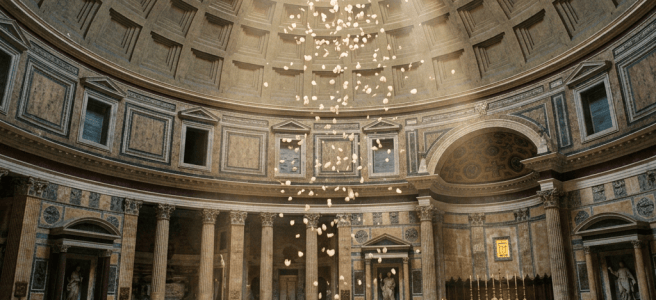
The Pantheon is still standing. The opening in the dome is still there. Every Pentecost, thousands of red rose petals fall through it, drifting down onto the altar and the people gathered beneath it.
Think about that image. The petals fall from heaven, settling on the place where the martyrs are remembered and where the Church gathers to worship.
Somewhere in that great multitude are people whose names we know. Our grandparents. Our parents. Friends we have buried. People who taught us to pray, who forgave us, who loved us when we were difficult to love.
And somewhere in that multitude, God willing, are the names of people who will one day remember us.
John could not count the crowd.
Neither can we.
But we know where it is going.
And by the grace of God, we are called to be part of it.


