
26th Sunday in Ordinary Time, Year A · Philippians 2:1-11
Everybody says they admire humble people. We say it about the star player who thanks his offensive linemen. We say it about the boss who remembers the janitor’s name.
Then we go home and check how many people liked our post on Instagram. You know the one we spent twenty minutes composing a “just thinking of you” post, then checked it eight times before breakfast.
We admire humility in other people. In ourselves, it feels a lot like losing.
Friedrich Nietzsche, a German philosopher, attacked the Christian view of humility. He coined the phrase “Master morality,” which comes from the ruling classes. They call themselves “good,” meaning noble, strong, healthy, and proud. Everything unlike them is simply “bad,” meaning low or common. It starts with self-affirmation.
The opposite, “Slave morality,” starts with reaction. The powerless can’t act against the powerful, so they build up ressentiment, a festering grudge. Their creative act is to relabel. The strong become “evil.” The slave’s own powerlessness becomes “good”: patience, meekness, humility, pity. Nietzsche blames priests for engineering this, traces it through ancient Judaism and calls Christianity its triumph. In The Antichrist (1888) he singles out Paul as the chief source of this, calling him a “dysangelist,” a bringer of bad news.
Resentment is real. You can watch it redefine words until morality itself is a weapon. You can watch it on both sides of every quarrel in this country. The left smells it in populist anger. The right smells it in victimhood. Both are quoting Nietzsche at each other and neither notices.
Genuine Christian love flows from abundance, not weakness. What Nietzsche described is not Calvary. It is the modern habit of performing a wound so that someone else will have to apologize. Social media pays for that performance. There’s a cheaper version that fakes it to get noticed. A comedy writer named Harris Wittels gave it a name: the humblebrag. “So humbled to be named one of the top forty under forty.” In 2018 researchers at Harvard Business School tested it. People liked the plain braggart better. They even liked the complainers better.
You have met them. At times each of us has been them. Fishing for compliments like Dicken’s Uriah Heep, who explains that his charity school drilled “umbleness” into him as a way to get ahead, and he hates his betters for it. “Oh, I’m nobody”—trolling for the extolling of his virtues. The martyr with a ledger of everyone else’s evil deeds. The old joke about the Sunday school teacher who finishes the Pharisee and the tax collector and says, “Now children, let’s thank God we’re not like that Pharisee.” If your humility is a way of looking down on the proud, Nietzsche has your number.
Philippi was a Roman colony, settled by army veterans. Its stones were covered with Latin inscriptions listing a man’s offices, one after another, climbing the ladder of honor. Their version of the bumper sticker “My son is a centurion.” Honor was life.
To that city, Paul writes: “Humbly regard others as more important than yourselves.” It was a word associated with slaves. Aristotle groups the tapeinos with the flatterer, the man who fawns.
And the cross was worse. Crucifixion was the slaves’ punishment.
Paul told those proud veterans’ families that Christ Jesus, “though he was in the form of God,” did not grasp at equality with God. He emptied himself, taking the form of a slave.” He was obedient “to the point of death, even death on a cross.”
Paul doesn’t argue with Nietzsche. He uses the word. Morphe doulou. The form of a slave. And he uses the same word, morphe, for his being God one verse earlier. The form of God. The form of a slave.
He didn’t “grasp,” a verb for seizing, even looting. It means something you use for your own advantage. Paul doesn’t say Christ pretended to be less than God. He had equality with God. He knew it. Yet he was willing to be one like us.
“he emptied himself.” Ekenosen. Four verses earlier, Paul warns the Philippians against kenodoxia, which means empty glory. The Philippians were full of empty glory, vainly trying to ascend. Christ had true glory and was willing to descend.
So is humility thinking little of yourself?
Aristotle’s hero was the magnanimous man, the great-souled man, who is worthy of great things and knows it. You’d expect a Doctor of the Church to throw that out. St. Thomas, whose classmates called him the dumb ox, keeps it. He says a person needs two virtues working together. Magnanimity pushes the soul toward great things, according to right reason. Humility keeps it from reaching for what isn’t its own. Magnanimity looks at the gifts God has given you and says, I’m meant for great things. Humility recognizes that we are creatures with faults and sins.
Humility is seeing yourself the way God sees you. The gifts are real. So are the flaws. The natural question is: how can I honestly regard everyone as better than me? Thomas’ and Paul’s answer is to see what’s God’s in my neighbor to what’s mine in myself.
Nietzsche’s whole theory needs one thing to be true. The humble have to be weak. Humility has to be what losers invent because they can’t win.
But Jesus is God. Nobody above him to envy. Nothing he lacks. Nothing to resent. And from there, he goes down.
Nietzsche’s theory can’t explain that. Resentment is what the bottom feels about the top, while the top tries to keep the bottom where it is. Jesus refuses to use his prerogatives for himself.
Three months before he died, Thomas Aquinas stopped writing. His secretary begged him to finish the Summa. Thomas said everything he’d written seemed like straw compared to what he had seen.
Nietzsche would call that the confession of a beaten man. A beaten man has nothing, though. Thomas had everything a mind can have. He looked at God and saw his own work clearly. Great things. Real gifts. Straw.
Jesus came down from heaven to a feed trough.
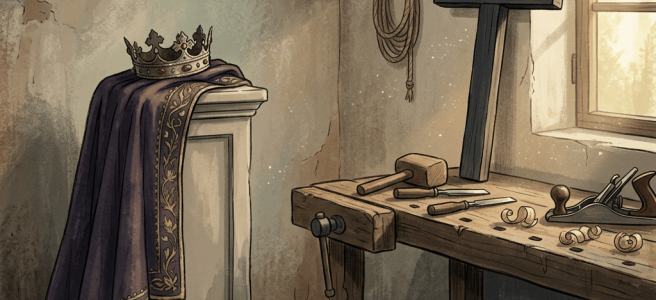
Down from a throne to a carpenter’s bench.
Down from the praise of angels to a crowd yelling “Crucify.”
Down to the slave’s cross. Down to the tomb. As low as a man can go.
But Paul says that’s ntot the full story. wait. Therefore.
Therefore God exalted him.
Up from the tomb.
Up past the soldiers and the seal on the stone.
Up to the right hand of the Father.
Up to the name above every name.
The way down was the way up. It always was. The proud are climbing the wrong ladder.


