
Twenty-Second Sunday in Ordinary Time, Year A
Jer 20:7-9, Ps 63, Rom 12:1-2, Matt 16:21-27.
You made it. Some Sundays that is a minor miracle and should be listed among the corporal works of mercy. Somebody found the car keys under a pile of permission slips. Somebody squeezed into last spot next to the minivan that parked like there was a bathroom emergency. Somebody got a toddler into a matching pair of shoes — one of which was found hanging off the ceiling fan, who knows how. Every week, life throws up a small obstacle course between the coffee pot and the pew.
But getting here is not enough. In many ways it is the easy part. We can be physically present and spiritually elsewhere. We can stand, sit, and kneel on cue and still not offer a thing. Our minds are already at brunch, already replaying Tuesday’s argument, already speculating on whether this homily is going to finish before the roast in the oven does. You can be here fifty-two Sundays a year and still miss the Mass you attended. Presence without offering is just geography.
Pope Leo challenged us about this a few days ago in his general audience. He quoted Saint Paul VI, who, even before the Council finished its work, insisted that the faithful “cannot and must no longer remain silent and passive,” because “their physical presence cannot be reconciled with their spiritual absence.” We do this constantly, and not only at Mass. We do it at our own dinner tables when the family is assembled, and everyone is still scrolling through someone else’s life. The body is in the chair. The mind has left the building.
In the letter to the Romans, Paul urges us, “by the mercies of God, to offer your bodies as a living sacrifice, holy and pleasing to God, your spiritual worship.”
That phrase, “spiritual worship,” translates the Greek logikē latreia. Logikē is the same root that gives us “logic.” Paul is not asking for worship in the vague sense of candles, feelings, and good vibes. He is asking for rational worship: worship that makes sense, given who God is and what He has done. The only reasonable response to mercy that large is to place your whole life on the altar and leave it there.
To make the point, Paul offers two verbs that should not be confused. Do not be “conformed” — syschēmatizesthe, from schēma, the outward shape, the costume — to this age. Be “transformed” — metamorphousthe, from morphē, the actual form underneath — by the renewal of your mind. One is a change of outfit. The other is a change of character. One rearranges the furniture. The other rebuilds the house.
Our culture has its own doctrine of transformation, and it is very loud about it. Curate your feed. Curate your identity. Become your most authentic self, preferably by Thursday. It sounds like Paul’s “renewal of the mind” wearing a hoodie and a wellness subscription. Everyone following the same self-improvement advice ends up optimized to look remarkably like everyone else: same routines, same vocabulary, same five inspirational quotes in the same sans-serif font. Even those who rebel against the culture end up doing the same thing as everyone else who rebels. Google, TikTok, and other algorithms have more say over what you want than you do.
I googled the lyrics of a Billie Eilish song. Now I am getting advertisements for colorful hair dyes. I got them often enough that for a second I’m thinking I need blue hair. Then, I remembered I actually need hair.
Advertisements can reshape appetites and desires. They can’t reshape a soul. That is the difference between a schēma and a morphē. Unfortunately, our consumer culture is stuck on the wrong side.
Peter, in today’s Gospel, falls into a similar pattern. Jesus has just told the Twelve that He must go to Jerusalem, suffer, be killed, and on the third day be raised. Peter takes Him aside — always a bad sign, the private correction of the Messiah — and says, in effect, “God forbid, Lord. That is not the brand we discussed.” Peter wants Christ without a Cross. He wants the costume of glory without the conversion of the heart. Jesus answers, “Get behind me, Satan. You are thinking not as God does, but as human beings do.” Then He turns to all of them: if you want to follow, deny yourself, take up your cross, lose your life. The living sacrifice is not a metaphor Paul invented. It is the center of discipleship.
What, then, is a living sacrifice? Saint Augustine stated: a true sacrifice is any work done to bind us in holy fellowship with God. He argued: the whole redeemed people, the whole Church, is itself the sacrifice, offered through Christ the great High Priest. “This is the sacrifice of Christians: we, being many, are one body in Christ. And this also is the sacrifice which the Church continually celebrates in the sacrament of the altar… in which she teaches that she herself is offered in the offering she makes to God.”
That is why Vatican II, in Sacrosanctum Concilium 48, refuses to let us remain “strangers or silent spectators.” The Church wants us to offer the Immaculate Victim “not only through the hands of the priest, but also with him,” and, in the same motion, “to offer themselves.” We are not watching a sacrifice happen up front like a cooking demonstration. We are joined to it. Christ, who is Himself the Logos, offers the one worship that is finally, fully logikē — entirely reasonable — because it is love holding nothing back. He does not do it without you. He invites you into His one singular sacrifice.
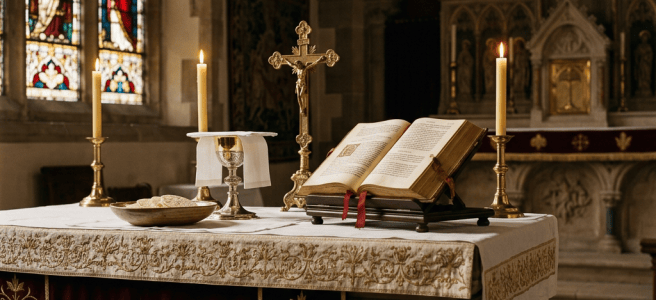
At the preparation of the gifts, the priest lifts the bread and says, “Blessed are you, Lord God of all creation, for through your goodness we have received the bread we offer you: fruit of the earth and work of human hands, it will become for us the bread of life.” Then the wine: “fruit of the vine and work of human hands.” The Church is not being folksy. What goes on that paten and into that chalice is already human labor, already the stuff of farms and kitchens and paychecks and tired Wednesday afternoons. Then, after the washing of hands, the priest turns and says: “Pray, brethren, that my sacrifice and yours may be acceptable to God, the almighty Father.”
My sacrifice and yours. Not his alone. Not a professional religious act performed ten yards away while you check the time. Yours. The toddler’s missing shoe. The quiet social cost of discipleship lived in the world. The argument you have not finished. Place it on the paten. Let it ride up with the bread. The offering that is actually holy enough to carry it is already there.
Do not wait until the parking lot to start living the Mass you just attended. When the gifts are raised, do not let your mind wander toward the roast in the oven. Offer the body you brought through the door — the one that found the keys, survived the minivan, and sat down anyway. Offer it as what Paul said it could be: a living sacrifice, holy and pleasing to God. Not a costume. Not a vibe. The real form, joined to His.

 The Joy of the Gospel