
Twenty-First Sunday in Ordinary Time — Year A
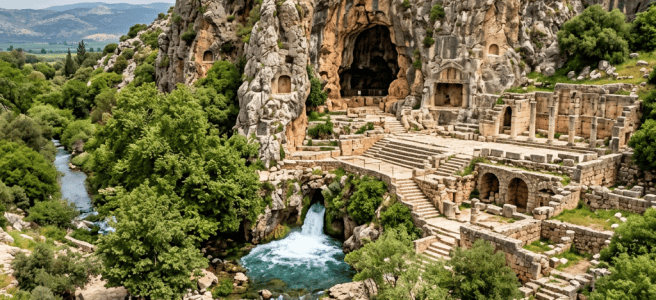
Geography can have theological significance. Caesarea Philippi is not a Jewish town. It’s intriguing that this is where Jesus asks the apostles who people say that he is. The city sits at the foot of Mount Hermon at the northern end of modern Israel. Water flows from a spring near its base, feeding the Jordan River. Josephus informs us that no one had managed to sound the depth of that pool. Which is historian-speak for “the hole is deeper than the length of our rope, so, underworld, probably.”
Greeks called it Paneas, after Pan, the goat-footed god of wild places, flocks, and panic – the source of, not protection from. He would scare those who disturbed his nap. His shrine was built in a cave in the cliff. Niches were cut in the rock for statues.
Somebody added a shrine to Nemesis. Her role was to make sure no one had too much good fortune. If your fortune exceeded its proper limits, she would bring you back down. According to Hesiod, she was the personification of Night. Her siblings include Death, Sleep, Strife, and the Fates. That is not a family you invite to dinner.
Herod the Great, never a man to let a good tourist attraction go unbranded, desperate to prove his loyalty (he had been on Mark Antony’s losing side during the Roman Civil War), built a gleaming white marble temple to Augustus. The pagan gods and earthly rulers were worshipped at a place locals believed was an entrance to the underworld, the realm of death itself.
This is where Jesus asks the question. Not in his hometown, not in the safety of Capernaum. Not in Jerusalem. Rather, in a city named for Caesar. A place where a bubbling spring flowed out of the netherworld; where pagan gods and human emperors were worshipped side by side.
“Who do people say that the Son of Man is?”
Easy enough question. Water-cooler discussions. Market talk. TikTok wisdom. Respectful guesswork. No need to own it. John the Baptist. Elijah. Jeremiah. One of the prophets. Complimentary answers. Not insults. But they keep Jesus neatly packaged. A prophet can be admired, argued with, and finally filed with the others.
Then the second question goes to the heart, asked near shrines to everything except the living God.
“Who do you say that I am?”
Not “they.” “You.” The Twelve. The disciples. Us. Peter answers for them, for all who truly follow Jesus: “You are the Messiah, the Son of the living God.”
“Living” God. Not Pan in the wet dark, not Augustus on a marble podium, not Nemesis in the cliff niches. The God of life, the anointed one—the source of salvation.
Peter confesses Jesus as Messiah and Son of the living God. Jesus blesses him, and then Jesus announces: “I will build my Church.” And against that Church, Jesus says, even the gates of Hades will not prevail.
The next few sentences past this scene, Jesus tells them that he must go to Jerusalem to suffer and die. Peter famously rejects that. Confession is not the same as understanding. Confessing Jesus is not yet following him to a cross. But it is where we begin.
Whom do we follow? Who do people say that he is? Our age has its own list that keeps Jesus at a useful distance. New Thought and New Age movements: he is a frequency that allows you to find yourself. For our therapeutic culture, he is a life coach, a source of comfort, affirmation, and personal growth, but not someone who confronts or demands. For some, he is a brand to be worn as décor but has less to do with the heart than Louis Vuitton.
But who do you say that he is? Not who the culture will allow. Not a convenient Sunday answer. But the answer that affects every day of our lives.
If he is only a life coach, we can pick and choose. If he is Messiah and Son of the living God, then we transform our lives around him in the Church he built. The gates of death do not get the last word, but the living God.
Jesus is not one god carved into a hillside niche next to Caesar and Pan. He is the living God. Not the god of panic, but the God of love. Not our Nemesis bringing us down, but our Messiah lifting us up. Not another Caesar on a white marble stage, demanding loyalty and promising the peace that lasts until the next civil war, but the living God who does not need an army and outlasts every empire that ever carved its name into a cliff.
He outlives them. He outloves them. The water that flows from his side from the cross is not from the netherworld but from the source of all life. It washes us. Cleanses us and transforms us into children of the living God. He asked Peter; now he asks us: Who do we say Jesus is?

 The Joy of the Gospel