
Every time I come across Hilary of Poitiers’s name, my brain sees Harry Potter. Hilary is known as “Hammer of the Arians,” not someone you want to be on the bad side of. Not a nickname you earn by bringing cookies to the parish council meeting. There’s a name for this condition, and it’s not “Father Pat needs new glasses,” though that’s also true.
I have what I call culturally induced paralexia. That’s actually a real thing. Although I may be the only documented case. Apparently, our brains can jump past letters to see patterns. Show me “Hilary of Poitiers” and my brain lights up like a Christmas tree that someone used as cover during the battle of Hogwarts.
I brought this up at a family dinner, hoping for sympathy. Instead, my nine-year-old nephew informed me, with the serene authority, that “Hilary sounds like a wizard name anyway, so it’s basically the same guy.” Grandma Geraldine slammed down her fork like a judge’s gavel. The look she gave the table was the one she saved for people who skip a fourth helping of her ranch-dressed German potato salad (a dish that never traveled to Germany). She’d never met Hilary of Poitiers, and doesn’t know what an Arian was. But she decided this was a matter of family honor. She wanted an apology letter. No matter that he was deceased. Grandma has never allowed a little thing like death to interfere with proper manners. So here we are.
For the record, Hilary was not a wizard. He was far more dangerous: a theologian with a spine. He lived in the fourth century, when the Church was arguing about whether Jesus is truly God or a created being or something more like a demiurge, Plato’s name for a “divine assistant manager.” The controversy was so fierce that our modern liturgy wars look like a polite disagreement over who left the milk out. Emperors took sides, bishops took sides, and people got banished. It was not a chill era.
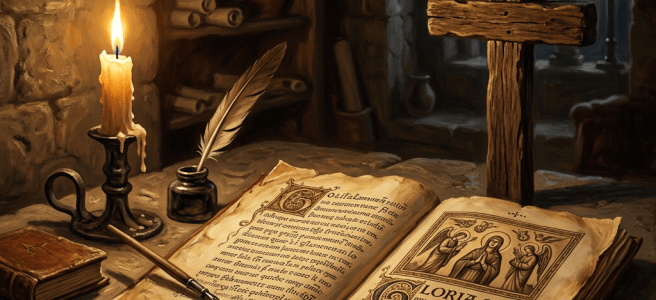
Emperor Constantius II banished Hilary to Phrygia (West Central Turkey). However, Hilary was so effective in exile defending the Trinity that the plan failed. Sending Hilary away had not made him less effective. He was returned to sender. Later medieval tradition holds that Hilary brought back the Gloria hymn from the Greek-speaking East to the Latin-speaking West, though the origins remain uncertain.
The opening comes from Luke 2:14, the song the angels sang over Bethlehem the night Christ was born. Uncle Uther would have sent a card, arriving around Valentine’s Day, or if you were lucky, a text saying “Confirming birth per earlier notice. Congrats. I guess. Card to follow.” The angels threw the sky open and sang instead, thunderous praise in the midst of a quiet arrival. That’s the song we’re invited to participate in, the one that starts at a feed trough and hasn’t stopped since. The “Lamb once slain stands in heaven.”
The Gloria begins with five acts of praise: We praise you, we bless you, we adore you, we glorify you, we give you thanks. There are petitions later, but it doesn’t open with “please help me find a parking spot.”
The hymn had a slow start in the Western Liturgy. Later traditions credit Pope Telesphorus (d. 137) for starting the Christmas Midnight Mass and ordering the Gloria sung at it. Telesphorus might be the unofficial patron saint of “we have always done it this way.” Except, historically speaking, we haven’t.
Pope Symmachus (d. 514), once a deacon himself, who spent most of his papacy locked in St. Peter’s while Laurentius, an antipope, controlled most of the churches in Rome, began the liturgical liberation of the Gloria. He allowed bishops to sing it on Sundays and feasts. Priests had to make do with Easter. Makes you wonder what his former pastor was like. By the eleventh century, its use had become more widespread. In other words, for several hundred years, it was easier to schedule the parish gym during basketball than the Gloria for liturgy.
Every Sunday, we step into a liturgy built by people like Hilary—people who fought, suffered, wrote, and prayed so that we could stand there and say, “Glory to God in the highest,” without having to invent it ourselves five minutes before Mass.
Left to our own devices, we’d praise God, certainly, but immediately move to other things. It would probably sound like: “Lord, we praise you, and also if you could fix my week, my back, and the parish copier, that would be great. Amen. Also, the coffee maker is making that grinding noise again.”
When we sing the Gloria, full of thankfulness, we join in the singing across the centuries, singing that unites heaven and earth, angels and all humanity. We are not starting from scratch. We are stepping into a song sung to shepherds in the fields, held up by saints who had better things to do than worry about whether their names sounded like wizards.
And if, for a brief moment, your brain tells you that one of them attended Hogwarts—just make sure you still give glory to God, not to Gryffindor. The House Cup is temporary. The Gloria is not.


