Fifth Sunday of Easter, Year A — May 3, 2026
Acts 6:1–7 | 1 Peter 2:4–9 | John 14:1–12
What have you done today? How would you answer? What exciting thing would you reach for or feel you have to make up to answer?
We have a very specific definition of “accomplishment.” It involves either an extraordinary achievement or at minimum an Instagram posting. You climbed something. You finished something. You attended something that had a name. You posted about it on TikTok.
Nobody says, “Today I did the dishes.” Nobody posts that. There is no highlight reel for clean forks.
And yet. Someone in your house is doing it. Quietly. Repeatedly. Without a single youtube posting..
There are whole categories of work that don’t exist in the eyes of the world until they stop. The laundry. The trash. The thing that makes the bathroom not horrifying. Nobody walks through your front door and says, “Incredible. The absence of dirty dishes is awesome!” That’s not how it works. But let the dishes pile up, and everyone has an opinion.
This is the invisible work problem. Not just in houses. In marriages. In friendships. In the long, unspectacular work of raising children, of staying faithful, of showing up for someone who doesn’t say thank you. Most of what holds a life together doesn’t look like anything when it’s done.
The world values visibility. God operates on a different logic of reality itself. Scripture shows it
Peter says:
“Like living stones, let yourselves be built into a spiritual house, to be a holy priesthood, to offer spiritual sacrifices acceptable to God through Jesus Christ.”
And then the climax:
“You are a chosen race, a royal priesthood, a holy nation, a people of his own.”
Peter is not handing out compliments. He names what Baptism has made us. He quotes Exodus 19:6. The moment Israel arrives at Sinai. Before the commandments. Before the law. God gives Israel its identity first.
God says: “If you obey my voice and keep my covenant” — that’s the condition — “you shall be my treasured possession, a kingdom of priests, a holy nation.” Identity before instruction. Vocation before law.
What does it mean to be a kingdom of priests?
First it means access to God. In the ancient world, most people were kept at a distance from the divine. You needed a priest to bridge the gap. But Israel as a whole is told: you will have that access. Not a few of you—all of you.
Second, it means a mediating role for the world. If priests stand between God and the people, then Israel is meant to stand between God and the nations. To show, in its common everyday life, what it looks like to live in the presence of the true God.
Third, it means holiness—not as a private feeling, but as a way of life. Every part of life (eating, marriage, work, justice) is ordered around one question: Does this draw us closer to God, or not?
And fourth, it means sacrifice. Not that every Israelite offered animals—that was the work of the temple priests—but that the whole life of the people was meant to become an offering. The people themselves were the sacrifice.
Peter takes that entire vision and plants it in front of you. What Israel was called to be, the baptized now are. You are a royal priesthood.
A priest offers sacrifice. So the question is: what is yours?
Augustine taught: A sacrifice is any work whatsoever done in order to cling to God in holy fellowship. Any work. Any act offered in love. And then he goes further. The whole redeemed people, the whole Church, is offered to God as one sacrifice through Christ the High Priest.
Which means you are not a spectator at Mass. You are part of the offering. The bread and wine carry you with them. Thus the symbols of the bread and wine emerge from the people and are brought to the altar.
But Peter’s “spiritual sacrifices” don’t stop at the church doors. The mother who was up at three in the morning with a sick child. She didn’t think of it as a priestly act. She was just exhausted. But if she offered that exhaustion to Christ — that was the royal priesthood at work. That was the altar extending into a bedroom at three in the morning. The small, hidden acts of love and endurance—these are the sacrifices of the royal priesthood.
Chrysostom said there are two altars. One is here, where the Body of Christ is offered. The other is outside, wherever the Body of Christ is in need. You can’t approach the first while ignoring the second. The royal priesthood offers at both.
Peter offers an image, calling us living stones. Not polished marble. Not architectural masterpieces. Stones. Ordinary stones, placed by a builder who knows what he is doing. The cornerstone is Christ. He holds everything together. You don’t have a million followers. You have to be in place.
The world measures a life by what it produces. Success. Recognition. Influence. Most lives, on most days, don’t produce much of those things. The royal priesthood has a different measure entirely. The smallest act, offered through Christ, gets taken up into something too large to see from here. There is no minor league in the priesthood of the baptized.
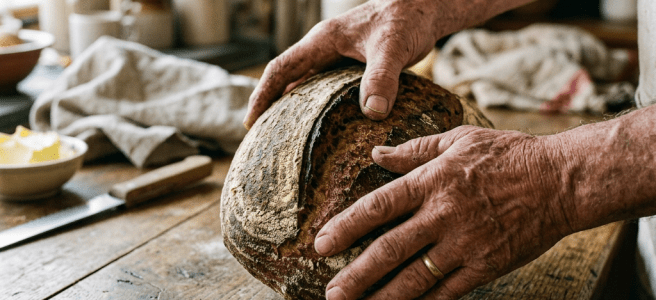
The Mass shows you the shape of it. Bread and wine, the most ordinary things there are, taken and blessed and broken and given. That’s it. That’s the priestly life. Take what is ordinary. Let it be blessed. Let it be broken. Give it. You were made for this. Not by Holy Orders — that belongs to the priest at this altar. By Baptism.
So this week, take one ordinary moment you would normally rush through or resent—the commute, the dishes, the conversation you would rather avoid—and before you do it, say four words:
Through Christ our Lord.
And do not rush past them. Because that is where the ordinary becomes an offering.
And nothing done in love is ever invisible.


