
Fourth Sunday of Easter — Good Shepherd Sunday (Year A) April 26, 2026
Readings: Acts 2:14a, 36-41| Psalm 23 | 1Pet 2:20b-25 | Jn 10:1-10
Coachella just ended.
For those of you who have successfully avoided knowing what Coachella is, congratulations—and please pray for the rest of us. It’s a music festival in the California desert. It began in 1999 as something raw and a little defiant. It lost money. That was part of the charm.
It does not lose money anymore.
Now it’s the Super Bowl of looking like you are having a better weekend than everyone else. Expensive tickets. Carefully curated outfits. Entire spaces designed so you can take the right photo in the right light and post it for the right reaction.
But this year, something new.
Some of the most viral content from Coachella was posted by people who were not there. Not because they were lying—they don’t exist. AI-generated faces. AI-generated bodies. AI-generated sunsets behind them. A fake person at a real festival, telling millions of real people what a great time she was having.
And many people couldn’t tell.
Think about that. The most shepherded generation in history is now being led by shepherds who aren’t there. Voices with no lungs. Faces with no bones. Calling—and being followed.
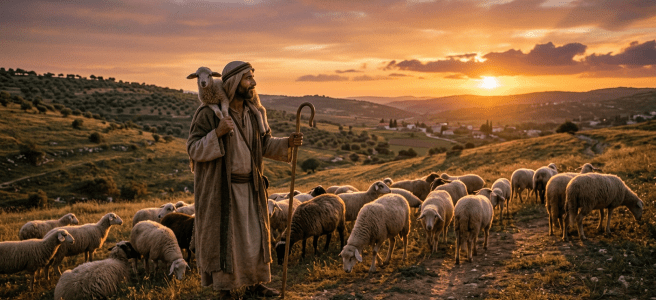
And into that world, Jesus says: “The sheep hear his voice… they know his voice… a stranger they will not follow.”
The sheep know the voice. Not because it’s the loudest voice. Not because it’s the most persuasive voice. But because it’s a known voice. A voice that has been heard before. A voice that calls each one by name. And that’s the real contrast Jesus draws. Not between good speakers and bad speakers. But between a true shepherd and a stranger. Between Jesus who gave himself for us and a TikTok celebrity who wants you to hit their like button.
There are many voices. Many teachers. Many promises of meaning, identity, fulfillment. The question is never simply whether they sound compelling. The question is: where did they come from?
Do they come through the door?
Or do they come from somewhere else?
A thief, Jesus says, comes to take. To use the flock. To gather attention, to hold it, to profit from it. The shepherd is different. The shepherd calls—not a crowd—but persons. Not a mass of followers—but names.
And we live in a moment that is deeply suspicious of that idea. The dominant voice of our culture says: you don’t need a shepherd. You need autonomy. You need to define yourself, construct yourself, become whoever you decide to be. Any voice that claims to tell you who you are—resist it.
That’s not a foolish argument. It comes from real experience. We have seen what happens when people trust the wrong voices.
Of course we are cautious.
But look at what the alternative has produced.
A generation told it could be anything has become a generation that often does not know what it is. Record loneliness. Record anxiety. A constant search for identity and very little confidence when it’s found.
Because the self cannot be its own shepherd.
Not because it is weak.
Because a shepherd, by definition, stands outside the flock.
You cannot lead yourself out of a place you do not know you are in.
And that is exactly what Peter says in the second reading:
“You had gone astray like sheep, but now you have returned to the shepherd and guardian of your souls.”
You have turned around.
You were following one set of voices.
Now you follow another.
So the answer is not silence in the sense of having no voices. That’s impossible. We are always listening to something.
The answer is learning to recognize one voice.
The voice that does not use you.
The voice that knows you.
The voice that calls you by name—and does not change depending on the audience.
So here is something concrete. This week, take fifteen minutes. No phone. No music. No background noise. Silence. And in that silence, listen.
Listen for the voice you have been drowning out.
The voice you knew before everything became so loud.
The voice that does not perform, does not manipulate, does not disappear when you need it.
If you have not heard it in a long time, that is not a crisis. That is what sheep do. They wander.
The Gospel does not begin with you finding the shepherd.
It begins with the shepherd calling you.
He stands at the door. He enters the right way. He calls his own by name. And the voice that calls you is the one voice in all the world that does not deceive—
because it belongs to a face that is actually there.
A voice that became flesh.
A shepherd who did not simulate his love, but laid down his life for his sheep.


