Every Mass begins with the sign of the cross: “In the name of the Father, and of the Son, and of the Holy Spirit.” Less than four seconds. Yet in that most foundational of prayers, usually somewhere between finding the hymn page and wondering if the mic is on, we are doing more than starting a ritual — we are stepping into missionary discipleship. Each time we trace that ancient gesture, we proclaim the heart of our faith to ourselves and to the world.
First, we mission to ourselves. The words name the trinity, the gesture remembers the incarnation, the cross traced across your body invokes the sacrificial power of God’s love. We remind ourselves, four seconds at a time, that we are not a consumer of spiritual content. We are disciples of the Crucified One.
Admittedly, we do not always perform it attentively. Take Uncle Uther, in the back booth of Chili’s. He bows his head over his chicken sandwich, makes the sign of the cross, and reaches for his fork. The tables around him freeze for a second. Was that a sneeze? A sudden neck stretch? A man quietly claiming his meal for Christ?
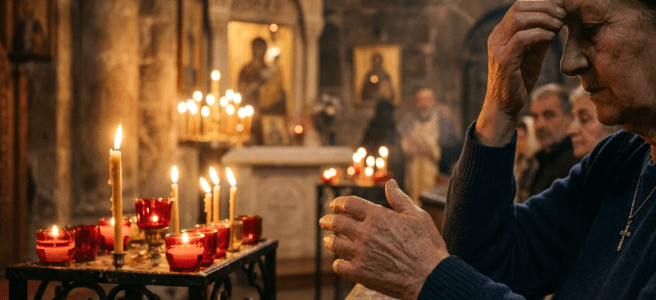
Then there’s Grandma Geraldine at the 9:00 a.m. Mass. She blesses herself while adjusting her glasses, scooping up a dropped hymnal, and waving at four people she hasn’t seen since Easter. Whether the gesture was actually completed is between her and the Holy Spirit, who has practice filling in the gaps.
The sign of the cross is missionary by nature. It’s four seconds of proclamation — sometimes crisp, sometimes gloriously improvised—that says: God is a community of persons. Jesus Christ was crucified for me. Love and the cross direct my life. You don’t need a megachurch stage, a viral video, or a TikTok self-disclosure. Your hand. Your words. Those four seconds — you proclaim a way of life, different from the world, not Christian lite.
There are versions of Christianity that offer lives of comfort. You can see the appeal. They ask a little less, explain away a little more, smooth out the sharper edges. And yet, quietly, almost imperceptibly, something essential goes missing: sacrificial love.
New Thought Christianity — God as life coach. Faith is a mechanism for manifesting your authentic self. Jesus endorses your best life now. The tone is upbeat, the goals are clear, and suffering is mostly a failure of mindset. The tragedy is that a crucified Savior does not fit easily on a vision board.
The Prosperity Gospel — New Thought with a private jet. God desires your flourishing—health, success, visible blessing—and the signs of grace start to look a lot like the signs of success. Meanwhile, St. Paul’s résumé (shipwrecks, beatings, imprisonment) is difficult to reconcile with the branding. It turns out the apostles would have made very poor influencers.
Moralistic Therapeutic Deism — less a movement than a cultural atmosphere. The creed, reconstructed from pseudo-therapy culture: Be decent. Feel okay. God is around here somewhere. The drama of sin and redemption fades into the background, replaced by a gentle reassurance that things are, more or less, fine. No one is quite sure what we were saved from, but we are glad it wasn’t too unpleasant.
Progressive Christianity — a sincere attempt to make faith intelligible and humane in a modern world. Doctrine softens into metaphor; difficult claims are reinterpreted; the scandal of the cross is translated into something more accessible. Yet a purely symbolic cross struggles to carry the weight of real guilt, real sin, real need for redemption. A metaphor can inspire—but it cannot bleed.
Seeker-Sensitive Mega-churchery — warm, welcoming, thoughtful, often doing real good for real people. Coffee, engaging talks, warm community, the messaging engaging, the barriers to entry low. And yet the cross has always been a strange thing to encounter—uncomfortable, disorienting, not easily made seamless. At a certain point, the question quietly emerges: if nothing unsettles us, what exactly has been healed?
Left Behind versions of dispensationalism — God loves his people so much he will airlift all faithful off the earth before suffering gets serious. An attempt to take God’s ultimate victory seriously. The hope is clear: that the faithful will be spared the worst of what is to come. Still, the earliest Christians seemed to expect not an escape from suffering, but the strength to endure it.
Each of these, in its own way, reaches for something good but they have lost sight of the power of sacrificial love. The cross refuses to be reduced, explained away, or made entirely comfortable. Avoiding its risks losing the person who redeems us.
Back in 350 AD, Cyril of Jerusalem told his catechumens to make the sign with boldness—not as a nervous twitch, not hidden away, not on autopilot before the rosary kicks in. Boldly.
In a world full of Christianity Lite options that ask almost nothing difficult, those four seconds are quiet resistance. The person who traces the cross before eating their chicken sandwich is saying out loud what no prosperity talk, no rapture novel, no flourishing seminar quite dares: God was crucified out of love, and this is the shape of everything.
Uncle Uther at Chili’s. Grandma Geraldine’s multimedia blessing. Every devoted, imperfect gesture of every Catholic who has traced the cross in a restaurant, a hospital room, a car before a hard conversation — witness, every one of them.
Make it deliberately. Make it with intention. Don’t hide it.
Tertullian made it before putting on sandals. We can manage before coffee.
Make it boldly.
This is the second entry in a monthly catechesis on the liturgy. Previously: Transforming Faith Through Genuflection. Next up: Headaches and the Theology of ‘The Lord Be With You,’ and A Hello That Hands You God’s Own Life.


3 thoughts on “The Sign of the Cross: Four Seconds That Witness Everything”
Comments are closed.