Homily for the Ascension of the Lord
Matt 28:16-20; Acts 1:1-11; Ps 47:2-3, 6-7, 8-9; Eph 1:17-23
We get into the sanctuary and, naturally, on our side there are three of us: Father English on one end, me on the other, and another priest in the middle. A seminarian comes over with detailed instructions. The priest in the middle sits first. Then the two of us on the ends sit down together, evenly, so the bench stays balanced. Fine. Perfect. We got this.
Except they explained how to sit down. They never explained how to stand up.
And suddenly my entire attention at Mass became: if Father English stands before I do, I am going straight onto the sanctuary floor in front of all the proud parents. Which would be terrible. Then I thought: if I stand up before Father English, that would actually be pretty funny.
I bring this up because the Ascension has something to say about people who arrive at a holy moment with their minds divided.
The eleven go up the mountain in Galilee. Matthew tells us they see the risen Christ. They worship him. “But some doubted.” Not before they saw him. Not on the way up the mountain. At the very moment of worship.
The Greek verb is distazō: to waver, to be split between two positions. Matthew only uses it one other time: when Peter begins to sink while walking on the water. It is the verb of someone trying to trust Christ while also wondering if the bench underneath him is stable.
And this is the group Jesus commissions. Not the perfectly confident. The wavering. The distracted. The ones still sorting themselves out even as they kneel before him.
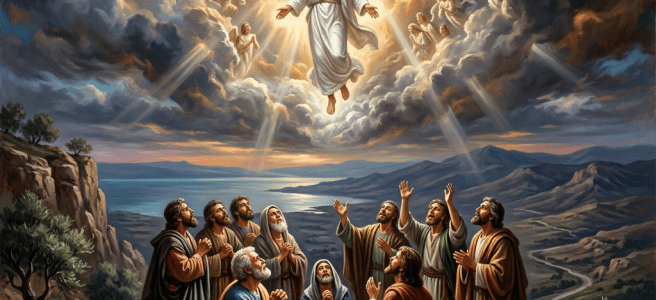
Then Acts gives us the same scene from a different angle. The disciples ask Jesus: “Lord, are you at this time going to restore the kingdom to Israel?” It is the last question they ask him on earth, and it is still the wrong question. They are thinking politics, borders, thrones. Jesus does not really answer it. He redirects them: “You will receive power when the Holy Spirit comes upon you, and you will be my witnesses to the ends of the earth.” And then he ascends.
There is a longing in every human being to rise. To matter. The secular world has its own version of ascension: career, reputation, followers, visibility. It recognizes something true: we were not made for the floor. But it gets the destination wrong. The world offers endless climbing without transcendence. You spend your life going up and discover the ladder is leaning against nothing.
Christ offers something entirely different. He ascends with our humanity fully joined to him. Pope Leo the Great stated: What was visible in our Redeemer has passed over into the sacraments. The body seated at the Father’s right hand is the same body born of Mary, the same body that ate with sinners and wept at Lazarus’ tomb. He did not discard our humanity when he rose. He carried it into heaven. Which means our destiny is already there.
And yet the angels say to the disciples: “Men of Galilee, why are you standing there looking up at the sky?” In other words: stop staring upward.
The Ascension is not permission for spiritual daydreaming. It is a commission. Christ ascends so that his work can continue through his Church, through ordinary people, in ordinary places.
So find one person this week who is convinced their life is going nowhere. Do not lecture them. Do not hand them a program. Just be present to them in a way that suggests you know something they have forgotten: that human life has a destination beyond success, beyond failure, beyond death itself. That is the Great Commission lived on a Thursday.
The disciples worshiped, and some doubted, and Christ sent them anyway. He sends us anyway too.
Just try not to stand up too early.


