
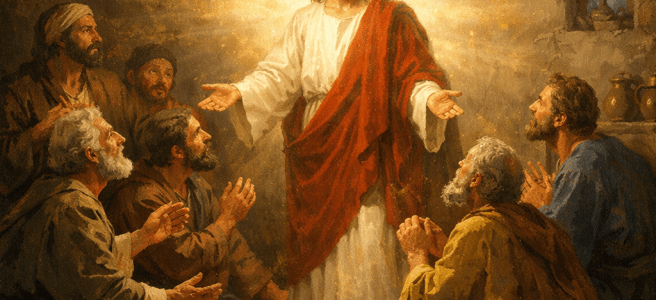
Second Sunday of Easter (Divine Mercy Sunday), Year A — April 27, 2026. Acts 5:12–16 | Ps 118:2–4, 13–15, 22–24 | Rev 1:9–11a, 12–13, 17–19 | Jn 20:19–31
There is a strange moment in history that happened in Halifax, England, in November of 1938 — a time when Europe was nervously eyeing Hitler, and Halifax was nervously eyeing pretty much everything else..
The town still remembered a real slasher from 1927 — a man who went around cutting women’s clothes with oddly fastidious precision, like a serial killer who moonlighted as a tailor. So when, on November 21st, a young woman named Mary Sutcliffe was walking home from the toffee factory, and a man jumped out from under a street lamp, raising his hand as if to strike, she blocked the blow and ended up with a cut.
That was all Halifax needed. Fear arrived on steroids.
The Halifax Courier offered a £10 reward for the arrest of the “Halifax Slasher.” Ten pounds in 1938 was serious money and an extraordinarily effective way to manufacture a slasher from thin air.
This was all the town needed. They already had a vague memory of an actual slasher from 1927. They had war anxiety. They had fog—lots of fog. They had the kind of economic stress that makes people shout at the radio. So naturally the entire town did what any clear-thinking community would do:
They lost their collective minds.
Vigilante groups appeared overnight, because nothing says “public safety” like roving bands of terrified citizens armed with whatever they found in the broom closet. People were mistakenly beaten up simply for looking like the sort of person who might own sharp objects—which in England includes literally everyone, because they all cook with knives.
Reports poured in: somebody was slashed here, somebody else over there. Police began to suspect there might be threeslashers operating simultaneously, because the incidents were happening faster than a single lunatic could logically manage without a good day planner.
Between 200 and 400 slashing incidents were reported.
Then the confessions began. One woman admitted she had scratched herself with a broken vinegar bottle. Another purchased a razor blade specifically to fake an attack so her boyfriend would pay more attention—because nothing says “romance” like self-inflicted flesh wounds. A teenager confessed she made the whole thing up after reading the papers. In the end, at least seven “attacks” were confirmed to be self-inflicted. Out of 21 investigated, only one was even possibly real.
The Halifax Slasher, as it turns out, was mostly… Halifax.
The panic didn’t just get silly—it got tragic. At one point a completely innocent man, already struggling with mental health, was accused, panicked, and died. Fear, not a slasher, took a life.
Finally, the same newspaper that had fanned all the hysteria published a headline that essentially said:
“Carry on Halifax! The Slasher scare is over… There never was, nor is there likely to be, any real danger to the general public.”
Which is the 1938 equivalent of: “Our bad.”
Halifax locked its doors against a phantom. The disciples locked theirs against a power that had proven it could crush them.
Their fear seemed reasonable. Every sign they had been given — and the world is generous with its signs — pointed the same direction. Power had spoken on Good Friday, and power had won. The man they followed had been arrested, tried, executed, and sealed in a tomb with a Roman guard. These were not vinegar-bottle scratches mistaken for razor wounds. This was the world operating exactly as the world operates: the strong survive, the weak are crushed, and hope is extinguished.
God refuses to play by the rules the world had written. The resurrection does not argue with the evidence of Good Friday. It walks through the wall that the evidence built and stands in the middle of the room and says something the Satan has no category for:
Peace.
Not the problem has been resolved. Not here is why things went the way they did. Not you should have known better.
Just: Peace.
The disciples weren’t in a Halifax panic. They were responding to the signs the world offers.
And Jesus walked through it.
Shalom. Eirēnē. Peace. Appears three times in this gospel passage. We say it at every Mass, right before Communion, and the very familiarity of it has perhaps blunted its edge. But John does not use words carelessly. When the risen Lord says eirēnē, he is not offering a pleasantry. He is performing an act — and he does it three times, each carrying a distinct gift.
.
In the Gospel, the doors are locked. The disciples weren’t praying. They weren’t waiting in hope. They were afraid. The Greek phobon — fear. The one they followed has been crucified, and for all they know, they are next. The room they occupy is not a sanctuary. It is a bunker. And into this sealed space, past the bolted door, past the barricaded hearts, Jesus came and stood in their midst.
The first peace addresses paralysis.
Jesus stood, estē. Not appeared, not materialized. He stood with intention and offered peace. Not a peace the world gives. Not a peace dependent on circumstances.They have not yet processed their grief. They have not yet been told what to do next. Peace comes first, as the precondition for everything that follows.
God’s mercy: it does not wait for us to get ourselves together. The risen Lord does not begin with an explanation. He begins with a gift, gratuitous and unconditional, the way all genuine gifts are.
Then he shows them his hands and his side, and the joy of the disciples is inseparable from the wounds. This matters enormously. The risen body of Christ is not a restored body, as though the crucifixion had been undone. It is a transformed body that retains the marks of what it underwent. The resurrection does not erase suffering; it transfigures it. The wounds remain, but they are no longer wounds of defeat. They have become the permanent testimony of love’s cost. — and, on this Divine Mercy Sunday, the open doors through which God’s mercy pours into the world.
The second peace inaugurates mission.
” I send you”. Peace first, then mission. The disciples cannot be sent while they are still hiding behind locked doors. Peace is not merely consolation — it is the precondition of movement. We cannot give what we have not received. We cannot bring shalom to the world from a posture of fear.
He breathes on them. This verb occurs in two other places in scripture. Gen 2:7, where God breathes life into the first human being, and Ezek 37:9, where God commands the breath to enter the slain and raise them to life. The risen Lord standing in that room is the new Creator, breathing into a new humanity. The disciples are not simply forgiven; they are reconstituted. The authority to forgive or retain sins makes mercy the defining vocation of the Church. We exist to extend into history what happened in that locked room on Easter evening.
The third peace arrives precisely where doubt has taken residence.
Thomas was not there. Perhaps had perhaps simply gone home,. The others had seen the hands and side without asking; Thomas wants the same evidence. The demand is not unreasonable. It is simply honest.
Eight days later, Jesus returns — the “first day of the week,” the pattern of Sunday assembly already taking shape. Again: shalom. The offer of the wounds is made; the sight proves sufficient. Thomas, the most resistant, reaches the Gospel’s highest confession: “My Lord and my God!” The one who doubted longest arrives at the deepest faith. Even through the testimony of a still-frightened community, the risen Lord can carry a person farther than they thought possible.
Halifax kept its doors shut for two weeks over a threat that never existed. The disciples kept theirs shut for eight days against a fear that had already been answered.
Jesus did not knock. He did not wait outside. He did not slip a note under the door explaining that things were going to be all right.
He stood in the middle of the room.
He showed them his hands.
And he spoke the first word of the new creation — the same word spoken into chaos in Genesis, the same word the Psalmist cries for, the same word the prophet promises, the same word now embodied in the one who has passed through death and come out the other side with it still on his lips:
Eirēnē hymin.
Not with an explanation. Not with a demand. Not with a reprimand.
Peace to you.
May it be so for you today — the peace that addresses fear, the peace that sends you, the peace that meets doubt and raises it into faith, the peace that is not a feeling but a Person, standing in the middle of every room you have locked, saying the first word again:
Peace be with you.

 The Joy of the Gospel