The goal of every Catholic parish is to create missionary disciples. Which sounds inspiring… until you try to do it. Then it feels like you were handed a shovel and told to redirect the Atlantic Ocean—ideally before the 10:30 Mass lets out, the coffee runs out, and someone corners you about why we don’t sing that one hymn from 1987 anymore.
So we stay comfortable. We settle for a faith that asks very little—and transforms even less.
Archbishop Pérez wants to change that. He’s calling the Archdiocese of Philadelphia to become a culture of evangelization—not through programs alone (though heaven knows we love a good parish committee), but through transformation. “Above all,” he says, we must “allow ourselves to be transformed by the Gospel so as to become missionary disciples.”
Here’s the quiet secret the Archbishop understands: Transformation doesn’t start in the mind alone. It also starts in the body.
Not with the big, heroic gestures we imagine we’ll make someday when we’re holier, more disciplined, and finally able to find the parish calendar—but with the small things we’re tempted to dismiss as “just rituals” or “Catholic weirdness.”
Want to become a missionary disciple?
Start with the knee.
The Body Catechizes Before the Mind Comprehends
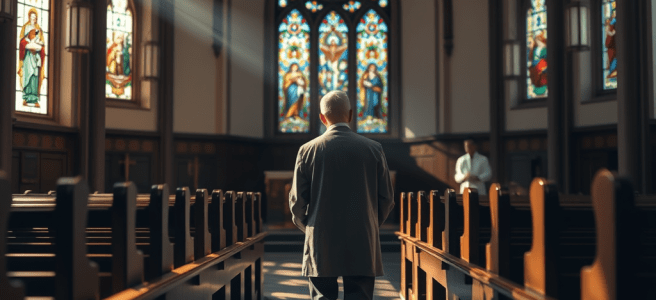
We genuflect in church—that brief drop to one knee before rising again.
Not just sitting politely like we’re at a piano recital where “Hot Cross Buns” becomes an extended meditation on patience and the theological virtue of endurance.
Not just standing along the back wall like Uncle Uther, who’s been holding up that same spot since 1987 and has never once considered the novel concept of sitting down; partly out of principle, partly because after thirty years he’s actually holding up the back wall.”
We drop a knee.
We do it when we enter the church and the Blessed Sacrament is present in the tabernacle. When we pass directly in front of the tabernacle.
(A brief pastoral aside: prudence should always guide us. For those whose knees have retired from active service: if your knees now sound like a gravel driveway being demolished—that symphony of pops, cracks, and sounds that make small children ask concerned questions—a profound bow from the waist works beautifully. If even bowing is difficult, a reverent nod of the head suffices. God invented your knees in the first place, so He knows when they’re not cooperating. He knows who has arthritis or gout. The point isn’t physical impossibilities; it’s recognition of presence. Make the gesture your body can make to recognize the One True God.)
Genuflection is basically treason against two dominant orthodoxies of modern life, which end up enslaving us:
Individualism: “I bow to no one—I’m autonomous, self-created like some kind of theological amoeba, and I take orders from nobody.”
Cultural Conformity: “You must bow—just to whatever we approved this week. Check the latest memo.”
The Catholic genuflection defies both. Which deeply unsettles everyone.
“Surely what matters is sincerity of heart, not physical gestures?”
To which the Church replies, with the patience of a mother who has already explained this twice and is now making deliberate eye contact:
We’re Catholic. We don’t do false dichotomies.
Your body can know things your brain doesn’t. To some, this sounds like something you’d hear at a yoga retreat or a very suspicious self-help seminar, but stick with me. The Church, in her ancient wisdom, has always understood what neuroscience is now confirming: embodied practices shape our consciousness. Habits form us. Rituals aren’t just “symbols”—they’re formative actions that make us into certain kinds of people.
St. Thomas Aquinas understood this: “grace does not destroy nature but perfects it” (Summa Theologica I, q. 1, a. 8). Grace doesn’t bypass your body—it works through it. When you genuflect, you’re training your body to recognize reality: God is present in the Eucharist and worthy of worship. St. Paul commands us to “glorify God in your body” (1 Cor 6:20)—not just with nice thoughts or vague spiritual vibes. The Catechism teaches that “the sacramental celebration is woven from signs and symbols” that are “fully revealed in the person and work of Christ” (CCC 1145).
Do this often enough, genuflect entering church, genuflect passing the tabernacle, and something remarkable happens:
Your body knows God is there before your brain catches up. Your knees figure it out before your theology does. They become small, creaky prophets.
This is formation. This is how you become a missionary disciple from the kneecaps up.
Catechesis Through Kneecaps
Our kneecaps can teach us when we are children.
Have your two-year-old genuflect every time they enter church. Don’t explain it yet—they’re two; their theological capacity tops out at “Jesus loves me” and “Goldfish crackers are delicious and also excellent projectiles.” Just help them drop the knee.
By four or five, add: “Jesus is there. We’re saying hello to Him the special Catholic way.”
By ten, they can discuss transubstantiation (CCC 1376) with enough sophistication to make TikTok theologians pause mid hot-take. But by then, their body already knows the truth. The doctrine just names what they’ve been living, what their knees have been confessing since before they could spell “Eucharist” (which, let’s be honest, many adults still struggle with).
This is liturgical catechesis: live it first, understanding follows. You learn to love God by worshiping God, not by mastering theories about worship first. It’s like learning to swim by getting in the pool, not by reading hydrodynamics textbooks poolside while wearing floaties and a concerned expression.
As Pope Benedict XVI noted, “The essential problem of our times…is that God has disappeared from the horizon of many people.” He disappears partly because we’ve stopped acting like He’s there. We’ve intellectualized Him, theorized Him, discussed Him to death—but we’ve stopped genuflecting before Him.
We’ve tried doing this the other way around—explaining everything first, practicing only if it “feels meaningful.”
It doesn’t go well.
It turns the Church into a hotel breakfast buffet: “I’ll take the social justice, hold the sexual morality, extra Vatican II—lightly interpreted, please—none of that genuflecting nonsense, why aren’t there donuts?” (There are rarely donuts. This is both a metaphor and a persistent disappointment.)
You assemble a plate. You feel vaguely satisfied… and remain profoundly undernourished. Because it turns out you can’t build a living faith by selecting only what already appeals to you. At some point, reality has to interrupt preference. At some point, you have to kneel.
Resisting the Idolatry of Rival Regimes
The early Christians refused to kneel to Caesar. And it cost them everything—their property, their freedom, their lives, and probably their social media accounts if those had existed.
But they bent the knee only to Christ.
We still have Caesars. They just wear better suits and have verified checkmarks, and send you targeted ads based on your search history:
Consumerism (you are what you buy—submit to Amazon, Temu, and social influencers who’ve never met a product they couldn’t monetize. Salvation arrives overnight with Prime.)
Christian Nationalism (confusing country with Kingdom, wrapping the Cross in the flag until you can’t tell which is which, treating the Constitution like it was etched on stone tablets and handed down from Mount Sinai)
Critical Theories (neo-pagan academic frameworks demanding religious devotion, treating dissent as heresy, and eating their own faster than the Revolution guillotined Robespierre—at least the guillotine was quick)
Therapeutic Self-Worship (you’re your own highest authority—follow your heart, even if your heart thinks gas station sushi at 2 AM is a good idea.)
Political Ideologies (promising salvation through ballots, as if changing the president could change the human heart, as if the right Supreme Court could solve original sin)
Internet Outrage (bow to the algorithm, confess your sins publicly, and pray nobody screenshots that thing you posted in 2009 when you thought you were being prophetic)
The Catholic who genuflects before the Blessed Sacrament is saying: “My ultimate allegiance is to Christ’s Kingdom, which is ‘not of this world’” (Jn 18:36).
When you’ve genuflected before the King of Kings, everything else seems… less ultimate. Even Uncle Uther, who has strong opinions about nearly everything, draws the line at genuflecting to trending hashtags. The practice trains you to spot pretenders to the throne—and resist them, no matter how loudly they demand your knee. This is missionary formation: learning to worship God alone so you can proclaim Him fearlessly.
The Persuasive Power of Peculiar Practices
Others notice when we genuflect. It’s foreign. Strange. Compelling. Sometimes off-putting, like watching someone speak a language you don’t understand but somehow still find beautiful.
Scott Hahn, in Rome Sweet Home, describes discovering the Catholic understanding of the Eucharist’s Real Presence. Part of that discovery was witnessing how Catholics worshiped—genuflecting upon entering church, pausing in reverence, treating the Blessed Sacrament as if Someone was actually there. Many converts tell versions of the same story: “I saw people dropping to one knee before this golden box. I didn’t know what it was. I didn’t understand the theology. But I knew they believed something was in there. I had to find out what.”
(Spoiler alert: it’s Jesus. It’s always Jesus. Catholics are remarkably consistent about this.)
The gesture evangelizes without words, proclaims without preaching. It says: “We believe something so particular, so embodied, so specific that we use our actual knees to acknowledge it. We’re not being metaphorical here. We mean it literally. Yes, we know our knees crack. Yes, we know it looks weird. We’re doing it anyway.”
This is Scripture’s scandal: “The Word became flesh and made his dwelling among us” (Jn 1:14). Christianity isn’t a philosophy you contemplate from a comfortable distance—it’s the outrageous claim that God became flesh and remains present in the sacraments, in concrete creational things. Bread. Wine. Water. Oil. Things you can touch, taste, see.
That claim requires genuflection.
This is exactly the evangelization Archbishop Pérez envisions: witness through distinctiveness, proclaim through practice, invite others through embodied faith that looks strange—even weird—to the world.
Missionary Knees Make Missionary Disciples
The Archbishop calls us to create “missionary hubs”—parishes transformed into centers of evangelization. That starts with missionary disciples. And missionary disciples are formed through practices that shape body and soul together—through habits that write themselves into our muscles and nerves before they write themselves into our theology papers.
If Catholics can’t maintain something as simple as genuflecting before God, how will we resist when culture demands we bow to market forces, ideologies, and the tyranny of self? If we can’t drop a knee in church, how will we stand firm in the public square?
The genuflection teaches three truths our culture desperately wants us to forget:
- There is only One worthy of worship (and it’s not you, your nation, your political party, or your preferred social theory)
- PWhat you do with your body shapes your soul (your body isn’t just along for the ride—it’s part of the journey)
- Obedience in small things prepares faithfulness in large things
As Jesus taught: “Whoever is faithful in a very little is faithful also in much” (Lk 16:10).
Want to become missionary disciples? Want to create a culture of evangelization?
Don’t start with a five-year strategic plan, three committees, and a logo that required fourteen emails, one passive-aggressive Zoom call where nobody’s camera worked, and a subcommittee that’s still technically in session. (Those things have their place, apart from the passive aggressiveness.) Want to renew a parish? Start with embodied practice. Start with a heart transformed. God’s grace will build on that. Start simple.
Start here:
Walk into church.
Find the tabernacle.
Drop the knee.
Do it when you feel devout.
Do it when you feel distracted.
Do it when your knee makes that noise—the noise Uncle Uther calls “perseverance” and your doctor calls “orthopedic inevitability.”
Because your soul will follow.
And so will those watching—drawn by the strangeness of people who still know how to genuflect, who still worship a God who doesn’t discard what He made, who still believe Christ entered creation and never left.
That’s how the revolution of the cross continues in us.
Not with manifestos. Not with feasibility studies or focus groups that meet quarterly. With one knee touching the ground, a heart transformed.

 The Joy of the Gospel