
Fourth Sunday of Lent — Year A | Laetare Sunday
1Sam 16:1b, 6–7, 10–13a | Ps 23 | Eph 5:8–14 | Jn 9:1–41
In the 1970s through the 1990s, a new idea swept through Western culture — schools, therapy programs, churches, youth groups, Christian formation programs, and eventually the trophy manufacturing industry, which was about to have its best decade since the invention of bowling.
The family therapist Virginia Satir looked at broken families and noticed something the rest of the therapeutic world had largely missed: the presenting problem was rarely the real problem. The kid acting out in school? Not the problem. He was the symptom. The problem was the invisible wound carried across generations — unspoken griefs, silences, secrets. Father’s father never talked about the war. Mother’s mother never spoke of her losses. And those silences travelled until they landed in a fourteen-year-old knocking over a mailbox in Iowa. She wanted people to understand that their problems were relational, not simply personal. She wanted them to know they were inherently valuable. It was compassionate. Relational. Profound.
Then popular culture found her. And like a toddler with scissors near a Rembrandt, it got… creative. Relational systems became self-esteem slogans. Emotional growth became the summit. Confronting painful realities was abandoned for compulsory affirmation. The nuanced clinical insight that healing requires naming the wounds carried silently across generations became something much simpler and considerably more cheerful: everyone should feel great about themselves, all the time, regardless of what they have actually done.
Children began receiving trophies simply for showing up. Soccer games ended with awards for everyone. By age twelve, some children had more trophies than top Olympic athletes. Teachers tiptoed around correction like bomb disposal units. Parents wrapped children in bubble wrap. Reality was officially banned.
When these children grew up, reality politely refused to cooperate. Universities found that students with the highest self-esteem did not always have the highest knowledge. In some cases, they had the lowest knowledge in recorded academic history, but they felt absolutely spectacular about it. Businesses found employees who expected raises but could not solve basic problems. This led to the need to create safe spaces and recognize trigger words.
Around 1975, some of these ideas wandered into Christian formation — retreats, seminars, workshops, and seminaries. The language of inner child work, self-worth, and interior wholeness appeared alongside the Baltimore Catechism.
Or, in many cases, instead of it.
To be fair, some of it genuinely helped. Pastors became better listeners. People learned to speak honestly about pain they had carried silently for decades. Emotional intelligence improved. These were real goods.
But slowly, almost without anyone noticing, a means became an end. Emotional growth was no longer a path toward God. It became the destination. Spiritual life became about becoming well-adjusted rather than about union with Christ.
A joke that circulated among priests formed in that era summed it up:
“We talked about our feelings so much that by ordination I knew my inner child very well — but I wasn’t sure I knew Christ.”
Psychological research later confirmed a danger in this flattening. Roy Baumeister discovered that high self-esteem does not reliably produce virtue, wisdom, or resilience. In fact, sometimes it produces the opposite: fragile, defensive, even aggressive egos when reality refuses to play along.
Psychological research later confirmed the danger in this flattening. Roy Baumeister found that high self-esteem does not reliably produce virtue, wisdom, or resilience. Sometimes it produces the opposite — fragile, defensive, even aggressive people when reality refuses to play along.
Two weaknesses, it turns out, were there from the beginning.
The first was Satir’s. Her framework, for all its genuine value, was entirely horizontal. It was a detailed map of the human interior, family systems, relational patterns, and generational wounds, but with no vertical dimension. No God. Not hostile to God. Just not there. All of it good. None of it, by itself, sufficient for the formation of a Christian soul. Because the soul is not simply a wounded self that needs healing. It is a creature that needs redemption. And those are not the same operation.
The second was popular culture’s contribution: the turn inward. Self-esteem as a project is about looking at yourself. Closely. Sympathetically. Repeatedly. With good lighting. Bubble-wrapped hearts became the norm. Self-feeling replaced Christ-centered transformation.
Which brings us to Scripture.
Not as man sees does God see, because man sees the appearance — but the Lord looks into the heart.
The question is not whether we feel good about ourselves.
The question is whose eyes we are using to see ourselves.
That question carries us straight into the first reading.
The Hebrew here is stark. Adam yir’eh la-‘einayim — man sees with the eyes. But God sees the lev, the heart, the innermost center of the person. Samuel, this great prophet who has anointed kings, who has walked with the LORD from his youth, who hears the voice of God in the night — Samuel looks at Eliab, the tall, handsome, firstborn son of Jesse, and thinks: surely this is the one. And God says: no.
Eliab was not the problem. The problem was Samuel’s eyes.
Seven sons pass before Samuel. The Lord rejects all seven. Jesse then mentions, almost as an afterthought, that the youngest is out in the field with the sheep. Nobody thought to call him. Nobody thought he was worth the trip.
The one God had already chosen was the one nobody thought to invite to the meeting.
The first reading is making a simple and unsettling claim. The eyes we use to evaluate ourselves and each other are not reliable instruments. We see the surface. God sees through it. And what God chooses, and what God sees as worthy, and what God loves — these regularly fail to match our expectations. When we see with the eyes of faith, we do not see less than others; we see more. We see what is hidden. We see the David in the field, the shepherd boy whom nobody thought to call, the one with the ruddy cheeks and bright eyes whom the LORD has already chosen and already loved.
Which carries us into John 9.
A man sits by the road. Born blind. The disciples ask the question that reveals more about them than about him: Rabbi, who sinned — this man or his parents?
They are working with the theological framework of their day. Suffering is punishment for sin. It was a tidy system. It explained everything. It was wrong.
Jesus rejects the premise entirely. Neither he nor his parents sinned. Jesus says something that sounds almost cold until you sit with it: this happened so that the works of God might be made visible through him.
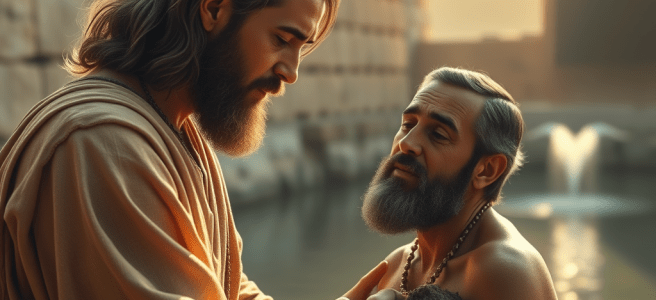
The Greek word for mud is pelos, and it echoes Genesis 2:7, where God forms the man from the dust of the earth. Jesus is doing what God did in the beginning. He is, as it were, finishing the job — completing a creation that sin had left incomplete. This man was born blind not because of his sin or his parents’ sin, as Jesus explicitly corrects the disciples’ assumption, but so that the works of God might be made visible through him. This sounds almost cold until you sit with it: this happened so that the works of God might be made visible through him. This man’s entire life of darkness — every stubbed toe, every humiliation, every day begging by the roadside — was not an accident of a random universe. It was, from all eternity, a vessel prepared to hold a particular grace at a particular moment on a particular road in Jerusalem, when the Light of the World walked by.
Then there is the pool. Siloam means Sent. Throughout John’s Gospel, Jesus is the one the Father has sent. The man born blind washes in the waters of the Sent One, and he sees.
The scrutinies of Lent — the ancient rites of prayer and examination for those preparing for baptism — were attached to this Sunday deliberately. The man born blind is every catechumen. He is every person who came to the font without sight and walked away seeing.
What follows is one of the strangest scenes in the New Testament.
The Pharisees drag this poor man before their tribunal not once but twice. They interrogate his parents. They abandon him to the wolves. He is of age, they say. Ask him. They are afraid of expulsion from the synagogue, so they hand their son to the authorities to protect themselves.
But their son does not abandon the truth. When the Pharisees insist that Jesus is a sinner, the man born blind says something that has echoed across twenty centuries: “Whether he is a sinner I do not know. One thing I know: I was blind and now I see.”They push harder. He pushes back. At one point he asks them, with what can only be read as a completely straight face, whether they would also like to become disciples of Jesus.
They throw him out.
The man born blind moves in one direction. He begins not knowing who Jesus is: he calls him the man called Jesus. Then a prophet. Then someone who must be from God. At the end, he says: Lord, I believe. And he worships him.
The Pharisees move in the opposite direction. They begin with a question and end with a verdict. They are not seeking truth. They are protecting a position.
The problem is not ignorance. The problem is the refusal to admit ignorance. The man born blind never claimed to know more than he knew. He only claimed to know what had happened to him. That was enough. That is the beginning of faith.
Jesus hears they have thrown the man out. And he goes to find him. He does not wait. He does not send a message. He goes.
And when he finds him, he asks: “Do you believe in the Son of Man?” The man says: “Who is he, sir, that I may believe in him?” And Jesus says: “You have seen him.”
You. Have. Seen. Him.
The man who was born blind — the man who had never seen anything in his entire life — the first human face he ever truly looked upon was the face of Christ. And Jesus tells him: that face you see? That is the Son of Man. That is the one you are looking for. And the man says, with the simplicity of every saint who has ever lived: “I believe, Lord.” And he worships him.
The self-esteem movement handed people a mirror and told them to look carefully at what was there. The man born blind found healing gazing upon Christ.
The question, then, is not whether God can open blind eyes. He has been doing that since the morning of creation. The question is whether we will do what the man born blind did — whether we will walk to the pool, wash, and come back seeing. Whether, when the world throws us out for insisting on what we know to be true, we will hold our ground with the magnificent stubbornness of a man who cannot explain the theology but will not deny the miracle.
I was blind.
Now I see.
That is enough. That is, in fact, everything.

 The Joy of the Gospel